Deck board spacing — the gap between decking boards — changes how many linear feet you order, how the surface drains, and how wood or composite handles seasonal movement. Gap too tight and boards can buckle; gap too wide and the deck feels uneven. Most pressure-treated and composite decks use 1/8 to 1/4 inch between boards. This US DIY guide covers gap charts for wood vs composite, how spacing fits the material formula, and how to avoid ordering one board short.
Why board spacing changes your decking order
Decking is sold by the linear foot or in standard lengths (often 8, 12, or 16 ft). Coverage per row includes the gap. A 5.5-inch board with a 1/4-inch gap covers about 5.75 inches per row — ignore the gap and you under-order by roughly 4%.
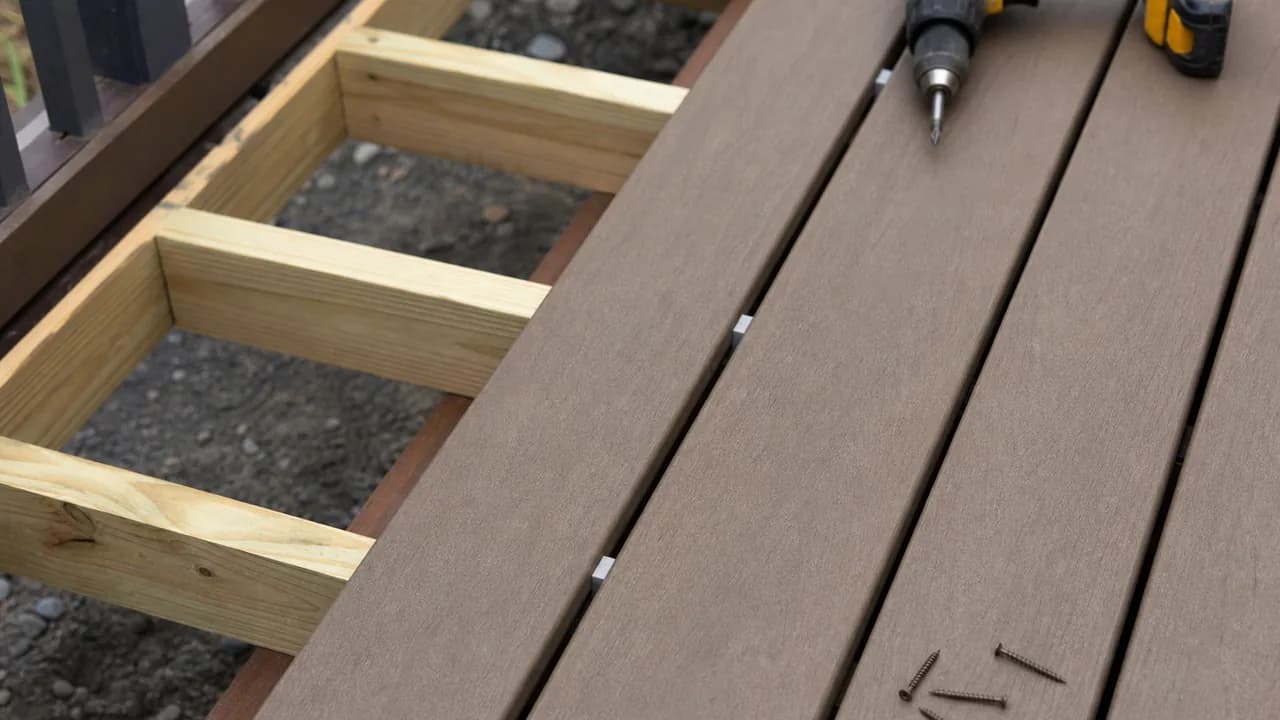
Spacing also affects drainage and drying. Tight gaps trap moisture on natural wood and can void composite warranties. Wider gaps drain better but may feel less comfortable under bare feet.
Hidden fastener clips usually fix the gap (often 1/8 inch). Face screws allow more flexibility, but you still need a consistent gap for clean looks and predictable math.
Deck board spacing chart (wood & composite)
Use this gap chart as a starting point. Always prefer the composite manufacturer’s published spacing when it differs.
| Material | Typical gap | Notes |
|---|---|---|
| Pressure-treated SYP (dry) | 1/8–1/4 in | 16d nail ≈ 1/8 in spacer |
| Pressure-treated (wet at install) | Thinner gap | Boards shrink as they dry |
| Cedar / redwood (KD) | ~1/4 in | More humidity movement |
| Composite / PVC | 1/8–3/16 in | Follow manufacturer warranty specs |
| Hardwood (ipe, etc.) | ~1/8 in | Less movement; still needs gap |
How spacing fits the material formula
Effective board module = actual board width + gap, in feet. Example: 5.5 in + 0.25 in = 5.75 in = 0.479 ft.
Linear feet ≈ deck area (sq ft) ÷ module (ft). A 12×16 deck (192 sq ft) with that module needs about 401 linear feet before waste.
Add 10% waste for straight runs — more for cutouts, angles, or stairs. Round up to the next full board length stocked locally.
Board lengths, butt joints, and fasteners
Stagger butt joints across joists — never line up end joints on consecutive rows. Offset by at least two joist bays when possible.
Hidden clip systems need the specified edge gap plus starter clips; order 10–15% extra clips. Face screws need two per joist crossing and pre-drilling on hardwood/composite.
Joist spacing (often 16 in on center) drives fastener count separately from board linear feet — use the Deck Calculator to test width and gap before you buy.
Practical examples
Standard rectangular deck
Scenario: 12×16 ft deck (192 sq ft), 5.5-inch boards, 1/4-inch gap, 10% waste.
Result: Module 5.75 in = 0.479 ft. Linear feet ≈ 401. With 10% waste ≈ 441 ft → about 28 sixteen-foot boards.
Composite with hidden fasteners
Scenario: 10×14 ft (140 sq ft), 5.5-inch composite, 1/8-inch manufacturer gap, 10% waste.
Result: Module 5.625 in = 0.469 ft. Linear feet ≈ 299 → ~329 with waste. Order 21 sixteen-foot boards plus clips per manufacturer chart.
Picture-frame border
Scenario: Field 11×13 ft plus a single-board picture frame on all sides.
Result: Estimate field area and border linear feet separately, then sum before waste — border corners create more offcuts than the field.
Common mistakes
- Using nominal board width only and ignoring the gap.
- Using the same gap for wet PT lumber as for kiln-dried composite.
- Ordering exact linear feet with zero waste.
- Forgetting picture-frame borders and stair treads.
- Mixing board widths without recalculating the module.
- Installing composite without checking manufacturer gap specs.
Recommended assumptions
Estimate decking linear feet
Enter deck size, board width, and gap to get a linear foot estimate with typical waste included.
Open Deck CalculatorFrequently asked questions
Most wood decks use 1/8 to 1/4 inch. Composite usually requires about 1/8 inch per the manufacturer. Keep a consistent spacer for even gaps.
Yes. Wider gaps mean fewer boards per row and more linear feet. Always add gap to board width when calculating coverage.
Pressure-treated softwood often uses 1/8–1/4 inch (tighter if wet). Composite and PVC follow the brand chart — typically near 1/8 inch — and ignoring it can void the warranty.
Add about 10% for a simple rectangular deck. Complex shapes, stairs, and picture-frame borders may need 12–15%.
Yes. Clip systems set a fixed gap (often 1/8 inch). Match clips to your decking profile and follow the spacing chart.