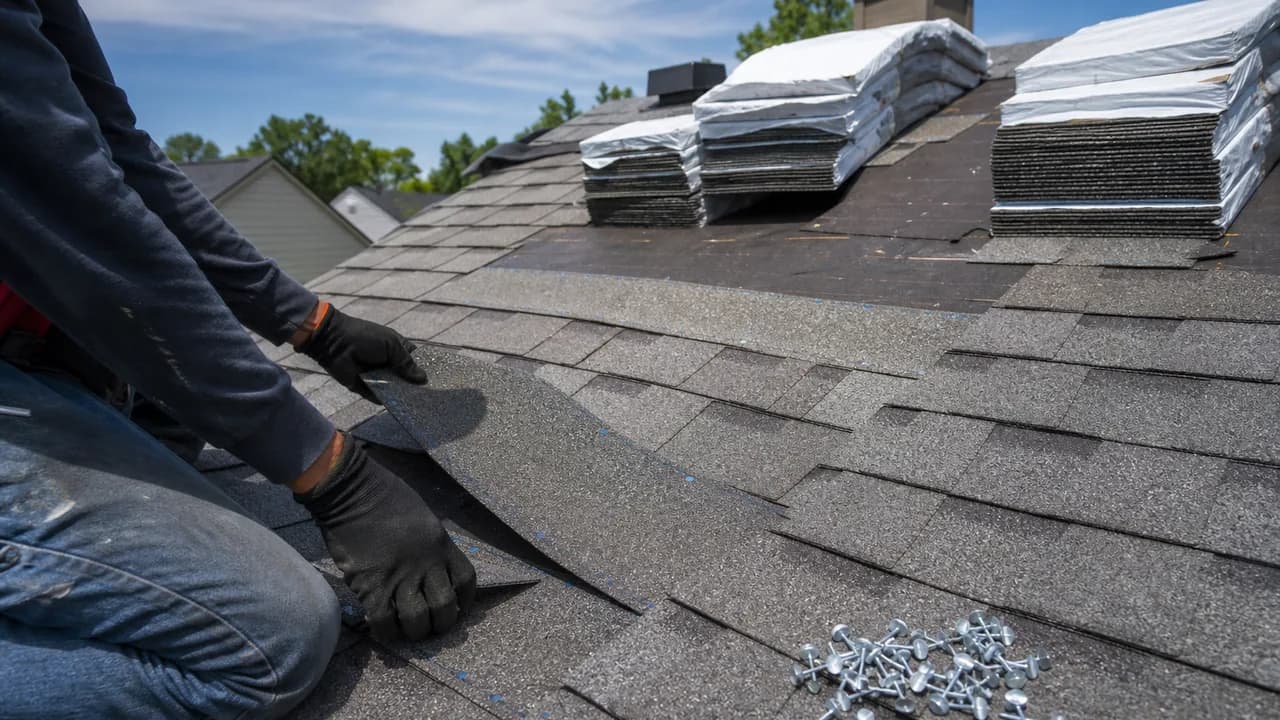
A roofing square is the unit US roofers use to measure and sell shingles: one square equals 100 square feet of roof surface — not 100 square feet of floor area inside the house. Pitch, overhangs, dormers, and valleys make roof area larger than the building footprint. This roofing square calculator guide explains how to convert roof square footage to squares, apply pitch multipliers, add waste, and order the right number of bundles.
Why roofing squares matter for estimates
Contractors quote asphalt re-roofs by the square — often hundreds of dollars per square installed. Misreading squares as floor area can skew a quote by thousands of dollars.
Shingles ship in bundles. Three-tab products usually cover one square with 3 bundles; thicker architectural shingles often need 4. Your square count drives the bundle order and the delivery check.
Underlayment, ice-and-water shield, ridge cap, and drip edge all hang off the same roof square footage math. Get squares right and the rest of the material list stays aligned.
Roofing square vs roof square footage
Roof square footage is the actual surface area of the roof in square feet. A roofing square is simply that area divided by 100. Twenty squares means 2,000 sq ft of roof surface — not 2,000 sq ft of living space.
US roofing and siding trades price materials per square. Always confirm whether a quote is material-only or installed, and that every bidder used the same square count.
Pitch multiplier chart for roof square footage
Start with the footprint of each roof plane as seen from above, including eaves and rake overhangs (often 12–24 inches). Multiply by the pitch factor below to get roof square footage, then divide by 100 for squares.
Use a level and tape in the attic (rise over 12 inches of run) or pick a common pitch in the roofing calculator if you already know the slope.
| Pitch (rise/run) | Approx. multiplier | Area vs flat footprint |
|---|---|---|
| 3/12 | 1.031 | +3% |
| 4/12 | 1.054 | +5% |
| 5/12 | 1.083 | +8% |
| 6/12 | 1.118 | +12% |
| 8/12 | 1.202 | +20% |
| 9/12 | 1.250 | +25% |
| 12/12 | 1.414 | +41% |
Bundles per square and waste factor
After you have squares, convert to bundles using the product label. Then apply waste before you order.
| Item | Typical value | Notes |
|---|---|---|
| 3-tab asphalt | 3 bundles / square | Confirm wrapper coverage |
| Architectural / dimensional | 4 bundles / square | Thicker profiles vary |
| Simple gable waste | 10% | Few valleys |
| Hip / multi-valley waste | 12–15% | Triangular cutoffs |
| Complex / dormers / skylights | 15–20% | Round up whole squares |
Roof features that add square footage
Dormers, hips, valleys, and intersecting planes add surface beyond a simple rectangle. Measure each dormer face and add it in. Include overhangs in the footprint before applying pitch.
For DIY estimates on busy roofs, break the roof into rectangles and triangles, calculate each, and sum. Satellite tools can help — still cross-check with a manual square count.
Practical examples
Simple gable ranch
Scenario: 30×50 ft footprint, 4/12 gable, 1 ft overhangs all around, three-tab shingles.
Result: Footprint with overhangs ≈ 32×52 = 1,664 sq ft. × 1.054 (4/12) ≈ 1,754 sq ft = 17.5 squares. With 10% waste ≈ 19.3 → order 20 squares (60 three-tab bundles).
Colonial with dormers
Scenario: Main roof 28×38 ft at 8/12, two 6×8 ft dormers at 6/12, architectural shingles (4 bundles/square).
Result: Main roof after pitch ≈ 2,558 sq ft; dormers ≈ 107 sq ft; total ≈ 26.7 squares. With 15% complexity waste ≈ 30.7 → order 31 squares (124 architectural bundles).
Garage hip roof
Scenario: 24×24 ft garage, 5/12 hip roof, three-tab shingles.
Result: 576 sq ft × 1.083 ≈ 624 sq ft = 6.24 squares. With 12% hip waste ≈ 7 squares → 21 bundles, plus ridge/hip cap by linear foot.
Common mistakes
- Treating roofing squares like interior floor square footage.
- Leaving overhangs out of the footprint and undercounting 10–15%.
- Skipping the pitch multiplier on anything steeper than ~2/12.
- Doubling a hip roof footprint the same way as a two-sided gable.
- Ordering 3 bundles per square for architectural shingles that need 4.
- Forgetting waste for valleys and hips and running short on the last course.
Recommended assumptions
Calculate roofing squares for your roof
Enter roof dimensions and pitch to get roof square footage, square count, and bundle estimates with waste included.
Open Roofing CalculatorFrequently asked questions
A roofing square is 100 square feet of roof surface area. It is the standard US unit for estimating and selling shingles, underlayment, and many roofing accessories.
Enter each roof plane’s length and width (including overhangs), select pitch, and let the calculator apply the pitch multiplier, convert to squares, and add waste. Then convert squares to bundles using your shingle label.
Divide roof square footage by 100. Example: 1,750 sq ft of roof surface = 17.5 squares. Round up after adding waste when you order.
Most three-tab asphalt shingles need 3 bundles per square. Many architectural (dimensional) shingles need 4. Always check the coverage printed on the bundle wrapper.
Yes. Steeper roofs have more surface area than the flat footprint. A 12/12 roof is about 41% larger than the same footprint measured flat. Pitch multipliers capture that increase.
They are useful and often within a few percent on standard roofs, but you should still verify pitch, overhangs, and waste. Cross-check with a manual roof square footage estimate before you buy.