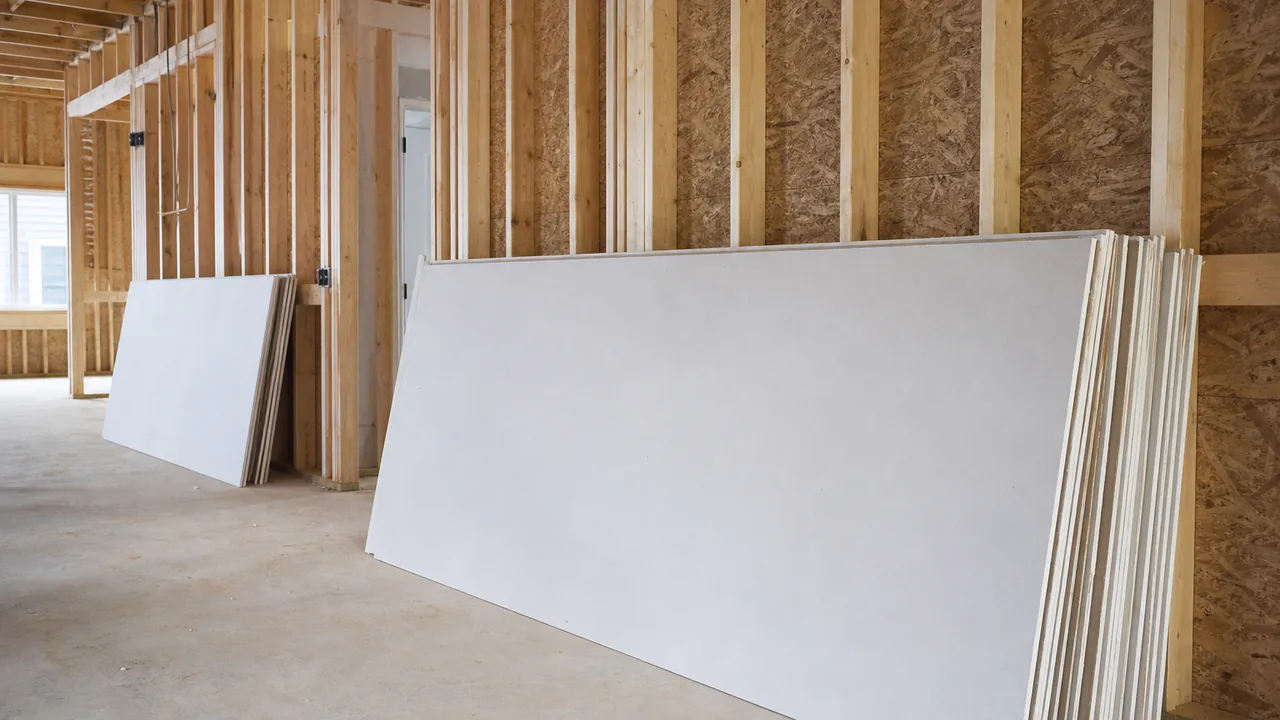
Drywall sheet size decides how many boards you buy, how many seams you tape, and how much waste you create. The standard 4×8 sheet covers 32 square feet; 4×10 and 4×12 sheets cut seam count on long or tall walls. This US DIY guide compares drywall sheet sizes, shows a coverage chart, and walks through how many sheets you need for a room — including waste.
Why sheet size affects your drywall order
Drywall is sold per sheet. A room with 480 sq ft of wall needs 15 sheets at 4×8 coverage, but fewer sheets if 4×12 fits the layout.
Fewer seams mean less taping and mudding. On a long wall, horizontal 4×12 sheets can cut butt joints versus stacked 4×8 boards.
Larger sheets can create larger offcuts in closets and cut-heavy baths — sometimes a wash versus 4×8 maneuverability.
Drywall sheet size coverage chart
Use this chart when comparing 4×8, 4×10, and 4×12 drywall sheet sizes. Thickness (1/2 in vs 5/8 in) does not change coverage area.
| Sheet size | Coverage | Best for |
|---|---|---|
| 4×8 ft | 32 sq ft | Small rooms, repairs, tight access |
| 4×10 ft | 40 sq ft | 9–10 ft walls; fewer seams than 4×8 |
| 4×12 ft | 48 sq ft | Long walls; tall rooms; fewer butt joints |
| 1/2 in thick | Same area | Most walls and ceilings |
| 5/8 in thick | Same area | Fire-rated / garage ceilings (check code) |
Choosing sheet size by room layout
If wall height is 8 ft or less, 4×8 sheets often fit vertically with no horizontal cut. For 9–10 ft walls, 4×10 or 4×12 may run vertically with fewer joints.
On walls longer than 12 ft, 4×12 sheets run horizontally to span with fewer vertical seams.
Closets, baths, and utility rooms usually favor 4×8 because longer boards are hard to turn in tight spaces.
How many drywall sheets do I need?
Total wall area ≈ perimeter × height (minus large openings if you deduct them). Divide by sheet coverage for the base count.
Add 10–15% waste for doors and windows; 15–20% for soffits, angles, or many openings. Round up to whole sheets.
After hang and finish, use the paint coverage guide for primer and paint gallons.
Practical examples
Standard bedroom — 4×8
Scenario: 12×14 ft bedroom, 8 ft ceilings, one door and one window, 10% waste.
Result: Perimeter 52 ft → wall area 416 sq ft. 416 ÷ 32 = 13 sheets. With 10% waste → order 15 sheets.
Tall great room — 4×12
Scenario: 16×20 ft room, 10 ft ceilings, long walls 20 ft, using 4×12 horizontally.
Result: Wall area 720 sq ft. 720 ÷ 48 = 15 sheets base. With ~12% waste → about 17 sheets and fewer butt joints than 4×8.
Small bathroom — 4×8
Scenario: 8×10 bath, many openings, net wall area ~180 sq ft, 15% waste.
Result: 180 ÷ 32 ≈ 6 sheets base → 7 sheets with waste. Prefer 4×8 for handling in the small space.
Common mistakes
- Using 32 sq ft coverage while ordering 4×12 sheets (48 sq ft).
- Forgetting ceiling area when finishing walls and ceiling.
- Ordering exact sheets with zero waste.
- Choosing 4×12 boards that will not fit through doorways.
- Mixing sheet sizes without recalculating coverage.
- Ignoring 5/8 in thickness requirements for fire-rated or garage ceilings.
Recommended assumptions
Estimate drywall sheet count
Enter room dimensions and sheet size to get a sheet count with typical waste included.
Open Drywall CalculatorFrequently asked questions
4×8 feet is the standard — 32 square feet per sheet. It is the most widely stocked and easiest size for DIY handling.
Estimate wall (and ceiling) area in square feet, divide by 32 for 4×8 sheets (or 40/48 for 4×10/4×12), add 10–15% waste, and round up to whole sheets.
Use 4×12 on long walls over about 12 feet and tall rooms where you want fewer seams. Plan for two people or a lift on ceilings.
Add about 10% for simple rooms and 15% for rooms with many doors, windows, or soffits. Always round up.
No. Coverage area is the same for 1/2 in and 5/8 in sheets of the same face size. Thickness is about code and fire rating, not square footage math.